Poverty, income inequality and living standards in Ireland: 6th annual report, September 2026
Barra Roantree, Helen Russell, Bertrand Maître, Cian Mowlds and Eva Slevin.
Available here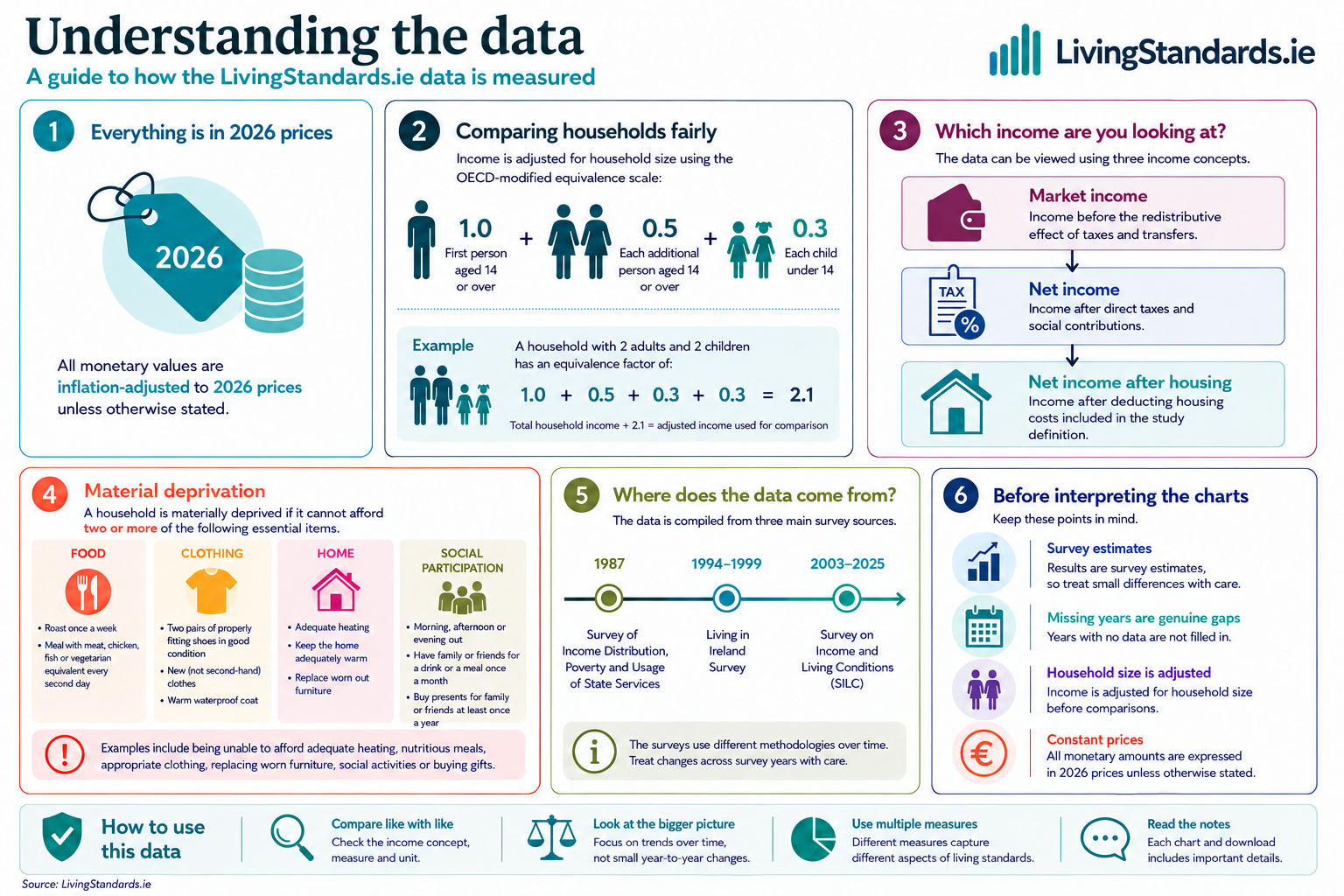
The explorer draws on the ESRI Poverty, income inequality and living standards in Ireland annual report series.
Barra Roantree, Helen Russell, Bertrand Maître, Cian Mowlds and Eva Slevin.
Available hereBarra Roantree, Bertrand Maître, Helen Russell, Anousheh Alamir, Míde Griffin and Tara Mitchell.
Available hereBarra Roantree, Bertrand Maître and Helen Russell.
Available hereBarra Roantree and Karina Doorley.
Available hereBarra Roantree, Michelle Barrett and Paul Redmond.
Available hereThe app uses the CFI-ESRI Poverty, Income Inequality and Living Standards spreadsheet. Monetary values are annual, equivalised household incomes in 2026 prices unless stated otherwise. Rates and shares are stored as proportions, and Gini coefficients are on a 0 to 1 scale.
Survey of Income Distribution, Poverty and Usage of State Services
The 1987 Survey of Income Distribution, Poverty and Usage of State Services was carried out by the Survey Unit of the ESRI in 1987 with the support of the European Commission and the Combat Poverty Agency. Results were first published in Callan et al. (1988), which reports that 3,286 households responded out of a valid sample of 5,155: an effective response rate of 63.7 per cent. These households contained just under 8,200 adults, each of whom was interviewed individually about their income sources and experience of the labour market. Weights were derived to correct for the greater likelihood of larger households being sampled (a product of the sampling frame being based on the electoral register and so households with more voters being more likely to be selected for inclusion) and a slight over-representation of older and rural heads of households. Analysis was carried out on the anonymised research microdata files held by the ESRI on its secure server.
Living in Ireland Survey
The Living in Ireland Survey was also carried out by the Survey Unit of the ESRI, beginning in 1994, again with the support of the European Commission. Each adult in a household completed an individual questionnaire through a face-to-face interview, with a similar initial sampling frame to the 1987 Survey. However, in keeping with the European Community Household Panel (ECHP) of which it was modelled, the survey adopted a longitudinal design with household members followed up in subsequent waves of the survey. By Wave 7 (2000), attrition was deemed to be a cause of concern and the original sample of individuals still in the scope of the survey (i.e. who had not died, moved to an institution or outside of the EU) were supplemented with a booster sample selected via a similar procedure as that used for the first wave of the survey. Weights were derived to correct for attrition and biases in the distribution of observed characteristics compared to the population of interest. There was an influx of more than 1,500 new individuals into the survey as compared to 5,530 from the original sample. However, to avoid any potential concerns about the representativeness of these later waves, we use only Waves 1–6 of the Living in Ireland Survey, spanning the years 1994–1999, with analysis again carried out on the anonymised survey microdata files held by the ESRI on its secure server.
Survey on Income and Living Conditions
The Survey on Income and Living Conditions (SILC) is an annual survey of households carried out by the Central Statistics Office (CSO) since 2003. Like the Living in Ireland Survey, it was initiated with the aim of collecting harmonised information on households for all countries in the European Union (EU). However, unlike the Living in Ireland Survey, it is not primarily a longitudinal survey with the vast majority of respondents sampled anew each year. We use the anonymised research microdata file data made available by the CSO to researchers through a secure virtual desktop infrastructure. Methodological changes to SILC in 2020 – including to the data collection and income reference period – have resulted in a break to the time series in a similar way to that between the Living in Ireland Survey and SILC.
The income series use the modified OECD equivalence scale: 1 for the first adult, 0.5 for each additional person aged 14 or over, and 0.3 for each child under 14. This differs from the CSO equivalence scale, so app estimates will not always match CSO-published figures exactly.
Material deprivation is defined as being unable to afford two or more of the ten basic items used in the ESRI report series.
This research has been supported by Community Foundation Ireland.
Community Foundation Ireland is a registered charity (RCN: 20044886) and leading philanthropic hub working to achieve equality for all in thriving communities. Established in 2000, it connects donors—individuals, families, corporates and trusts—with over 5,000 community and voluntary partners across Ireland. Its mission is to deliver strategic, long-term social change by funding initiatives that tackle inequality, support inclusion, and empower generations.